ICE-CEMDuke University

Vision: Distributed, Adaptive Cyber-EM Kill-Webs

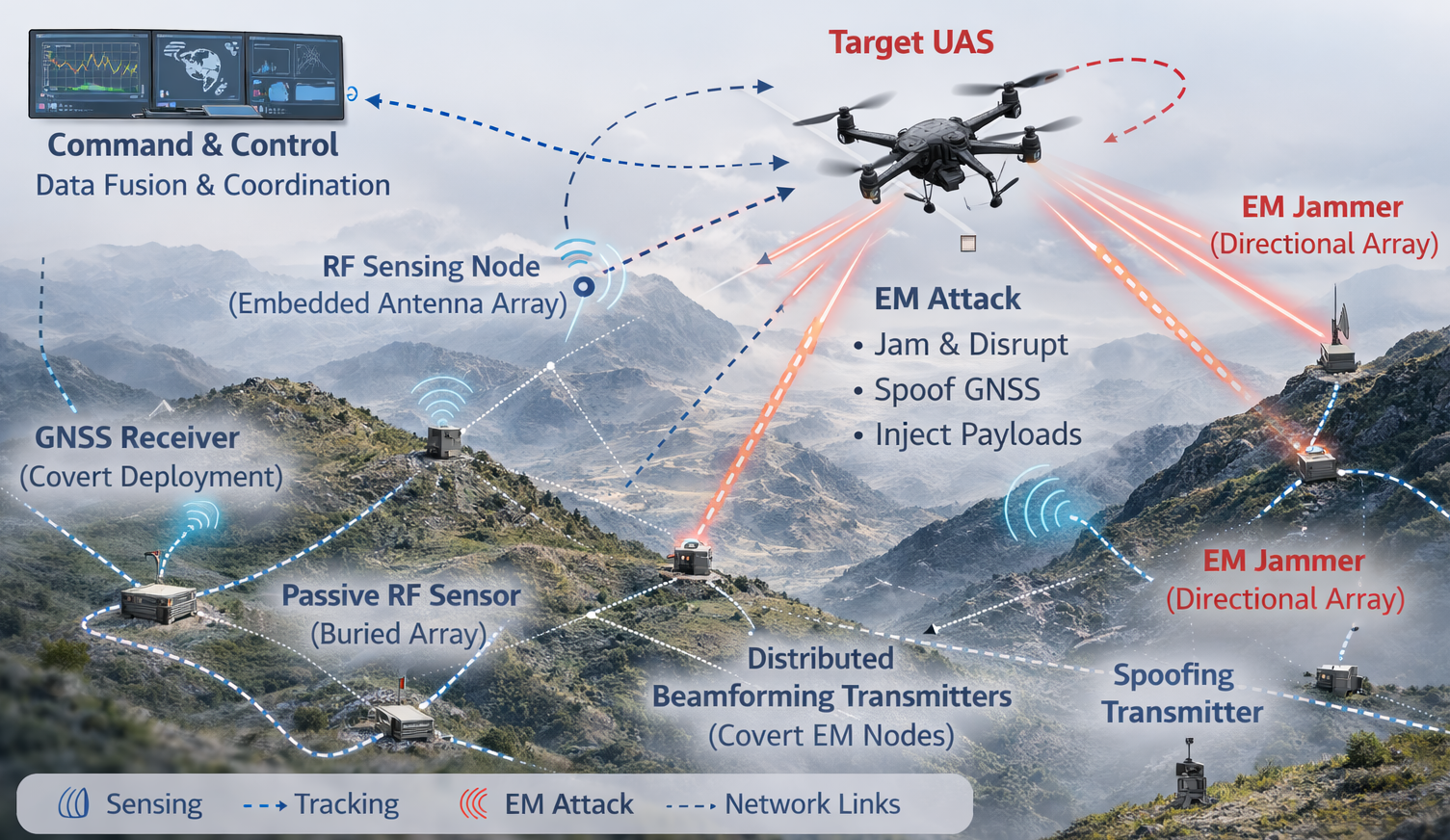
Conceptual distributed cyber-EM network linking sensing, command and control, and multiple electromagnetic platforms around a target UAS.

The new cyber-EM capabilities will evolve traditional linear kill-chains into distributed and adaptive kill-webs that exploit cross-domain causal dependencies among sensing, communications, computation, and control to compose reliable mission-level effects under uncertainty. ICE-CEM will establish the cyber-EM kill-web as a new paradigm with rigorously quantified tradeoffs in attack reliability, cost, energy, time, and robustness under uncertainty and active countermeasures.

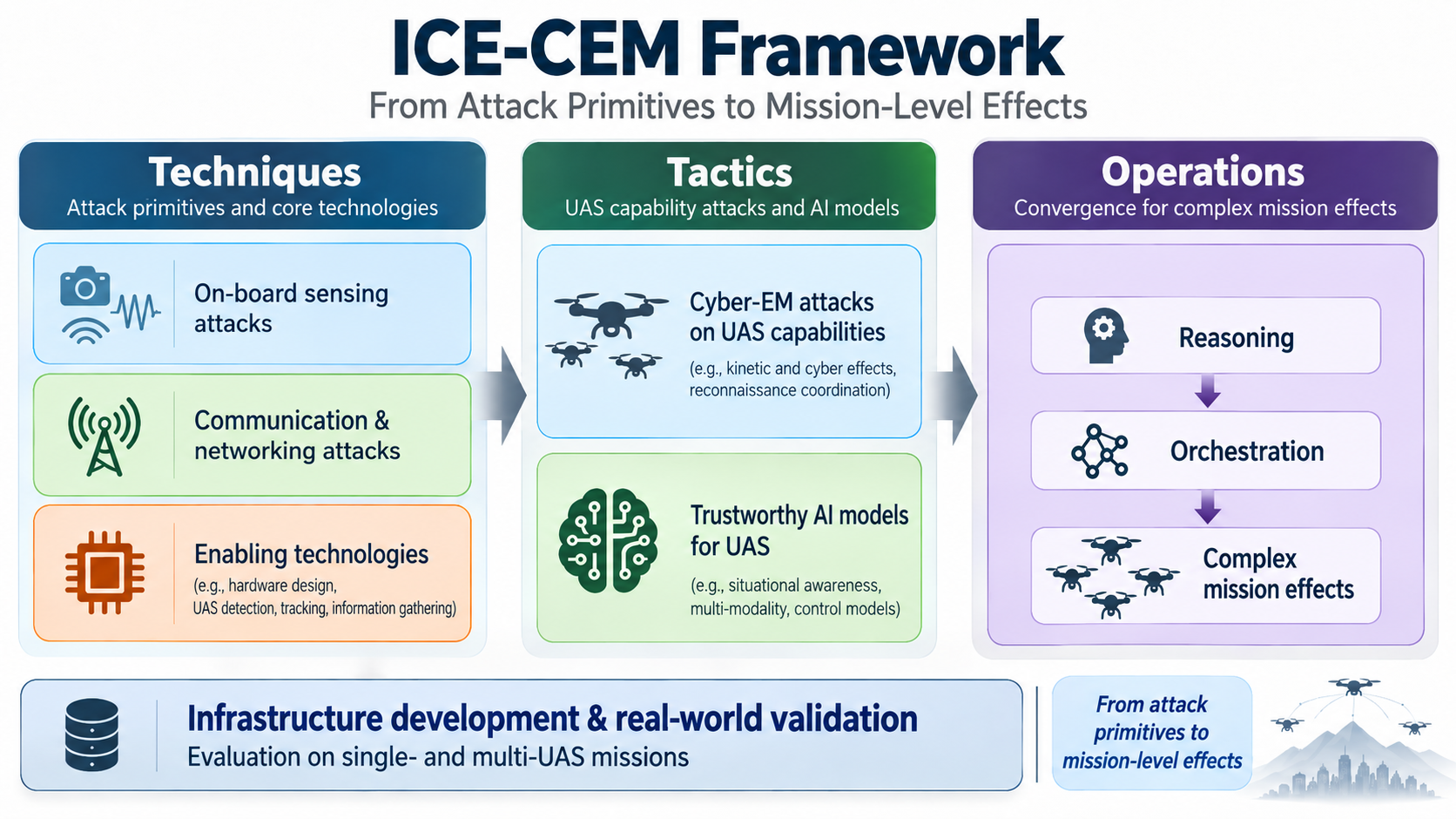
ICE-CEM research architecture: techniques include sensing attacks, communication and networking attacks, and enabling technologies. Tactics combine cyber-EM attacks on UAS capabilities with trustworthy AI models. Operations use reasoning and orchestration to produce complex mission effects. Infrastructure development and real-world validation support all three levels.
From parameterized cyber-EM primitives to adaptive mission-level operations.

The Cyber-EM Action-to-Effect Pipeline

ICE-CEM will formalize an action-to-effect pipeline that links cyber and electromagnetic actions to physical, cyber and reconnaissance effects. It follows how interactions propagate through sensing, communication and networking, hardware and computation, and control, providing a common structure for the research areas below.

EM Pillar

Electromagnetic Attack Primitives, Platforms, and Enabling Technologies
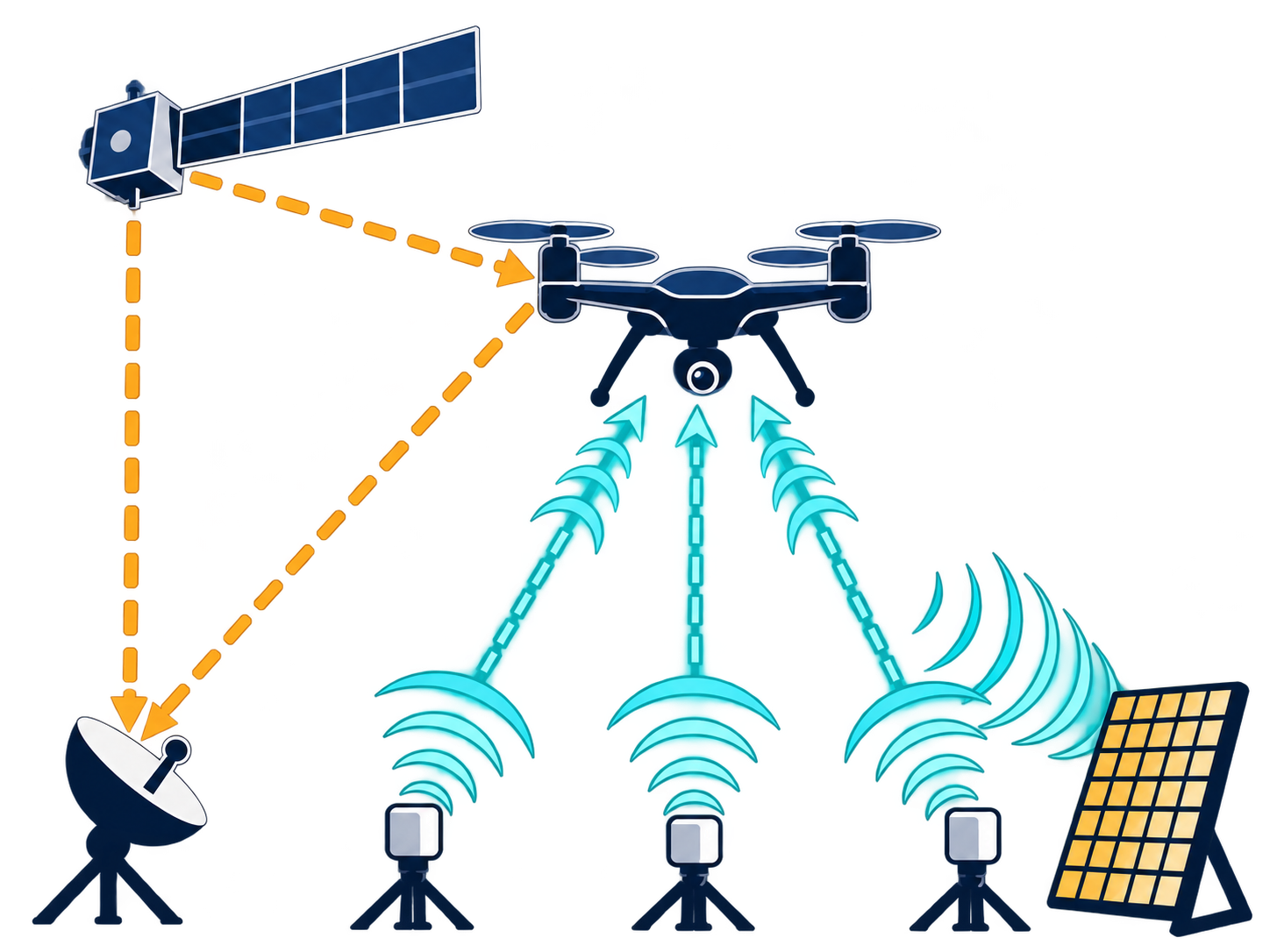
Concept illustration of satellite signals reflected from a UAS to a passive receiver, coordinated RF nodes forming a beam toward the UAS, and a reconfigurable metasurface shaping electromagnetic waves.

We will systematically investigate and characterize the EM threat landscape for UAS and develop EM attack primitives (i.e., techniques), the platforms and enabling technologies needed to realize them, and corresponding defense mechanisms. We will formally model and experimentally characterize these capabilities to quantify their operating requirements, constraints, reliability and robustness. Each primitive will be characterized by its required target knowledge, hardware and platform resources, operating range, and energy and timing constraints. Enabling technologies—including mobility-aware distributed beamforming, active and passive sensing, and reconfigurable metasurfaces—will support the delivery and evaluation of these capabilities under realistic conditions.
Cyber Pillar

Cyber Exploitation and Trustworthy AI

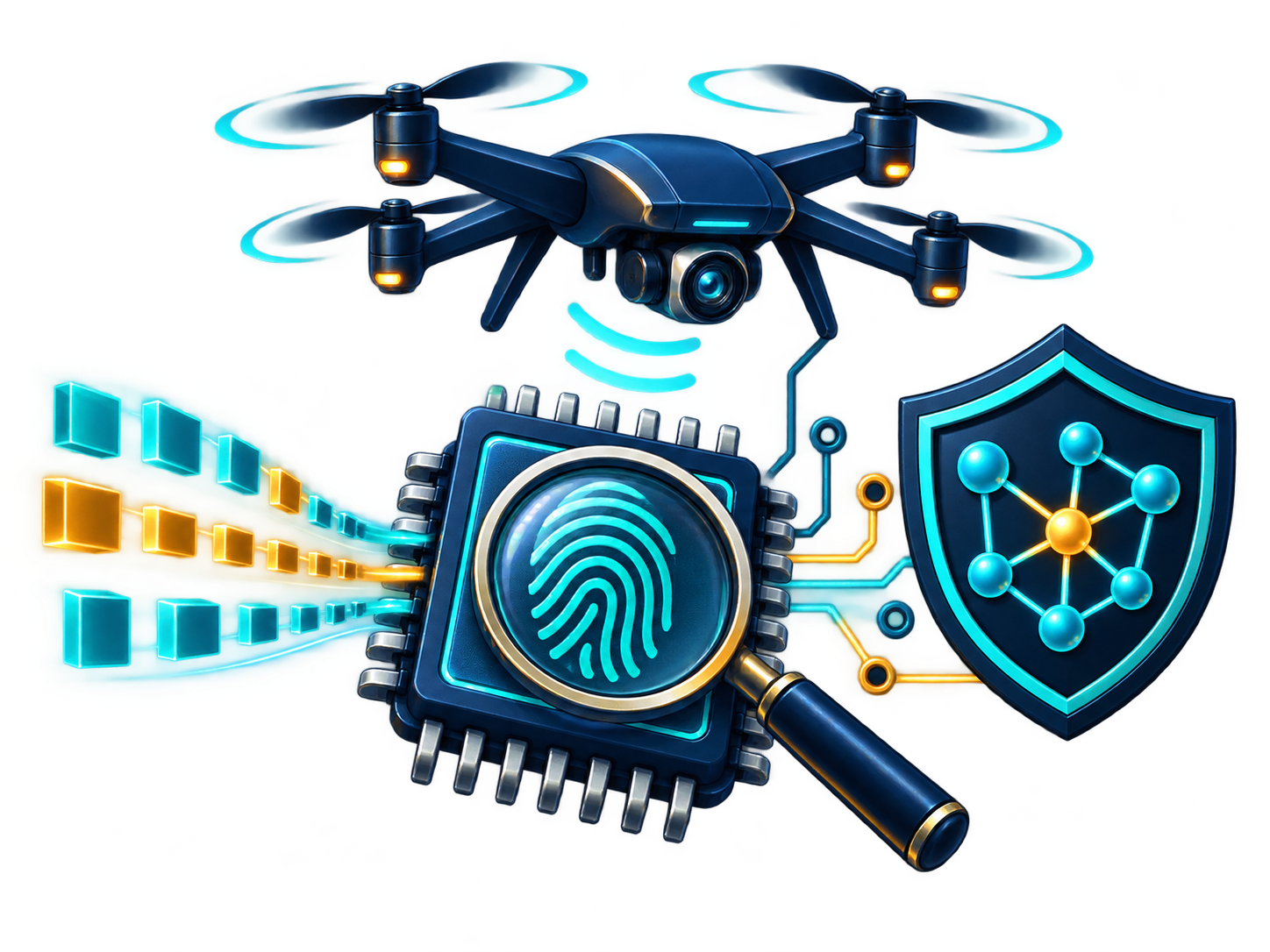
Concept illustration of a UAS above a firmware chip inspected through a fingerprint magnifier, varied data inputs representing fuzz testing, and a neural-network shield representing trustworthy AI.

We will characterize and fingerprint UAS platforms and discover vulnerabilities through firmware reverse engineering, protocol analysis and fuzzing. This work will identify exploitable weaknesses in communication protocols, software stacks and onboard computation, including vulnerabilities exposed or amplified by EM interactions.

We will develop tactics that combine EM primitives with cyber methods to affect key UAS capabilities. This includes physical outcomes across navigation, control, coordination, planning and decision-making; cyber outcomes involving network access and platform execution; and reconnaissance outcomes that support information gathering and target understanding.

Research on trustworthy AI will address both current perception and decision-making models and emerging end-to-end systems that map multimodal sensing directly to control actions, alongside methods for defense and verification.

Convergence Pillar

Cyber-EM Convergence and Adaptive Operations

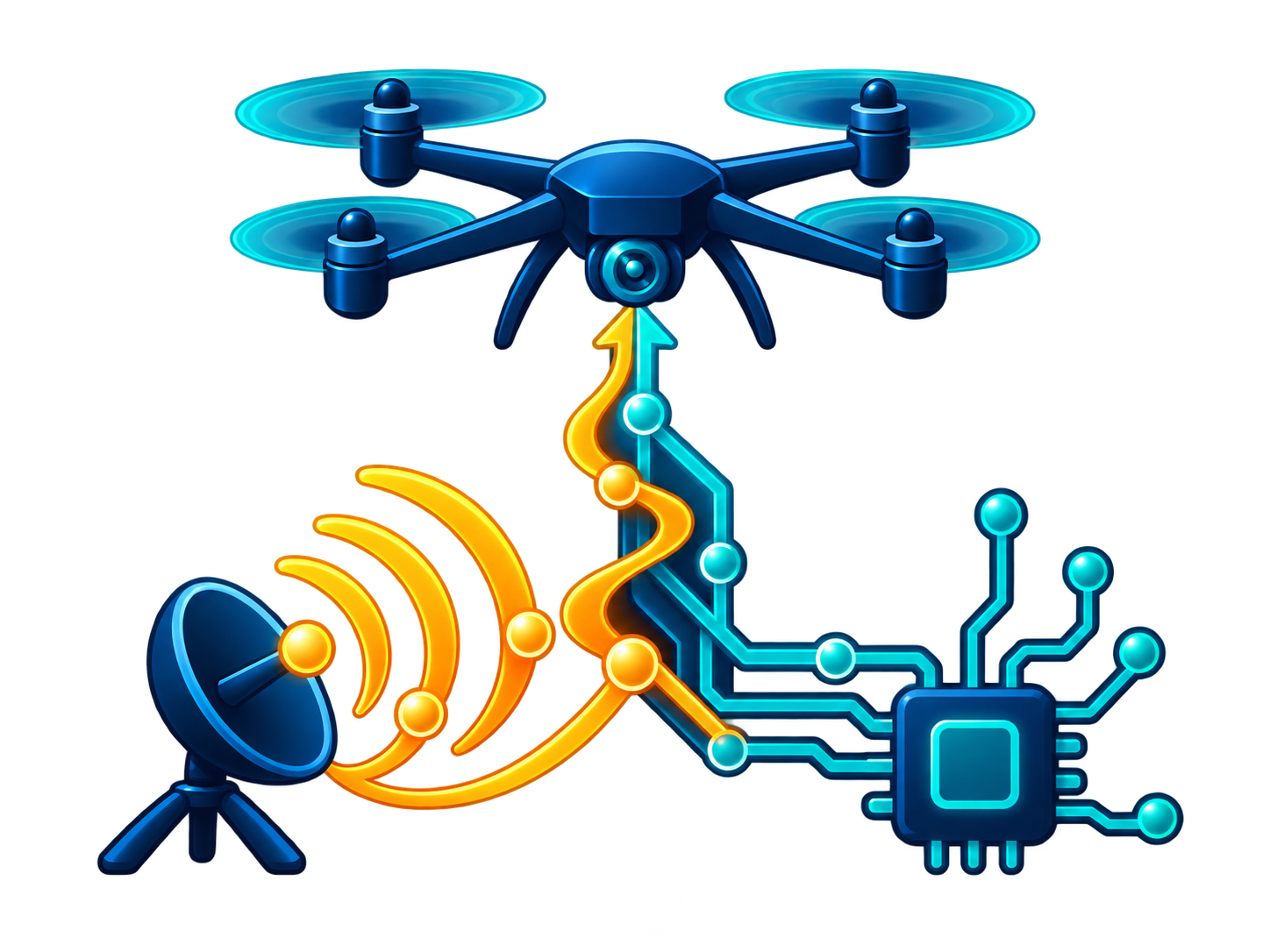
Concept illustration of electromagnetic waves from an antenna and cyber circuit paths merging into a shared pathway toward a UAS.

We will build on the EM Pillar’s formally characterized primitives and models to trace how EM-induced phenomena propagate through sensing, communication and networking, hardware and computation, and control into longer-term physical, cyber and reconnaissance effects. They will guide the parameterization of EM actions over time and the generation of physically realizable data manipulation sequences for real-time controllers and decision-support systems.

Building on this foundation, information-flow analysis and probabilistic cyber-EM attack graphs will encode cross-domain dependencies and connect lower-level tactics to mission-level objectives. Learning and decision-theoretic methods will support objective decomposition and adaptive policy generation under limited target knowledge, uncertainty, resource constraints and active countermeasures. The framework will also support adaptive replanning while quantifying operational success, information leakage and collateral risk.

Integration and Demonstrations

From Foundational Science & Technology to Realistic Operational Demonstrations

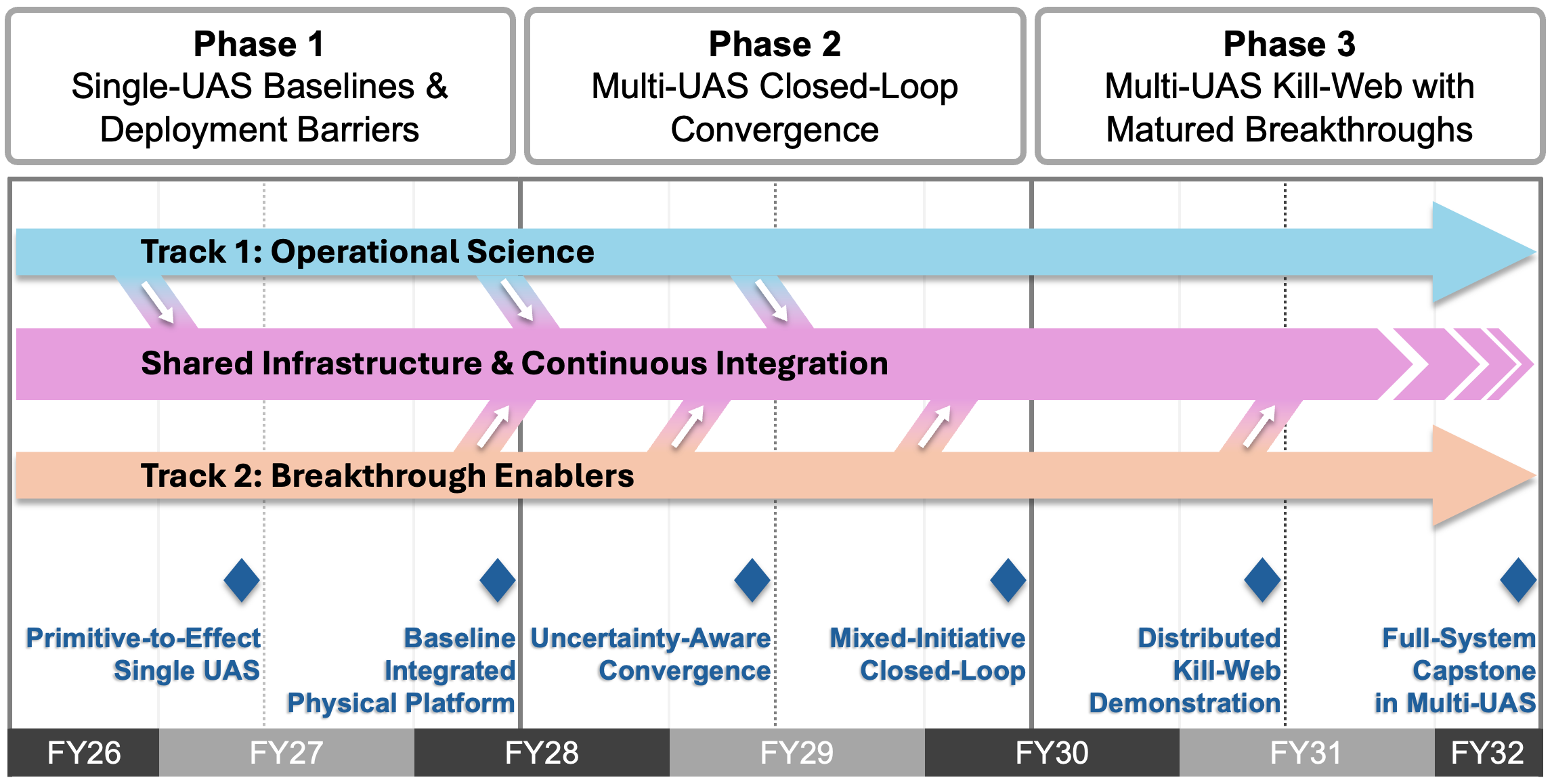
Three phases progress from single-UAS baselines and deployment barriers to multi-UAS closed-loop convergence, then a multi-UAS kill-web with matured breakthroughs. Operational science and breakthrough enablers feed shared infrastructure and continuous integration, with progressive demonstrations.

A coordinated, dual-track strategy will connect scientific advances to progressive system-level demonstrations. One track will integrate mature cyber-EM capabilities into representative UAS scenarios; the other will develop higher-risk enabling technologies and bring them into shared experimentation infrastructure. Integrated testbeds will support single- and multi-UAS evaluation, with experimental results used to test assumptions, compare approaches and refine the framework. Demonstrations will center on a U.S. mobile asset in a contested semi-urban corridor, with threats escalating from isolated surveillance drones to autonomous heterogeneous swarms as capabilities mature from foundational baselines to distributed cyber-EM kill-web operations.

From vulnerability discovery to operational capability—at mission speed.

Meet ICE-CEM Team ↗

Our institutions

Duke University The University of Texas at Austin WashU — Washington University in St. Louis Penn State Georgia Tech University of Michigan Lockheed Martin