NOVEMBER 2–3, 2026
ICE-CEM Kickoff
Our team and partners come together at Duke to launch a shared research agenda.
Meeting information ↗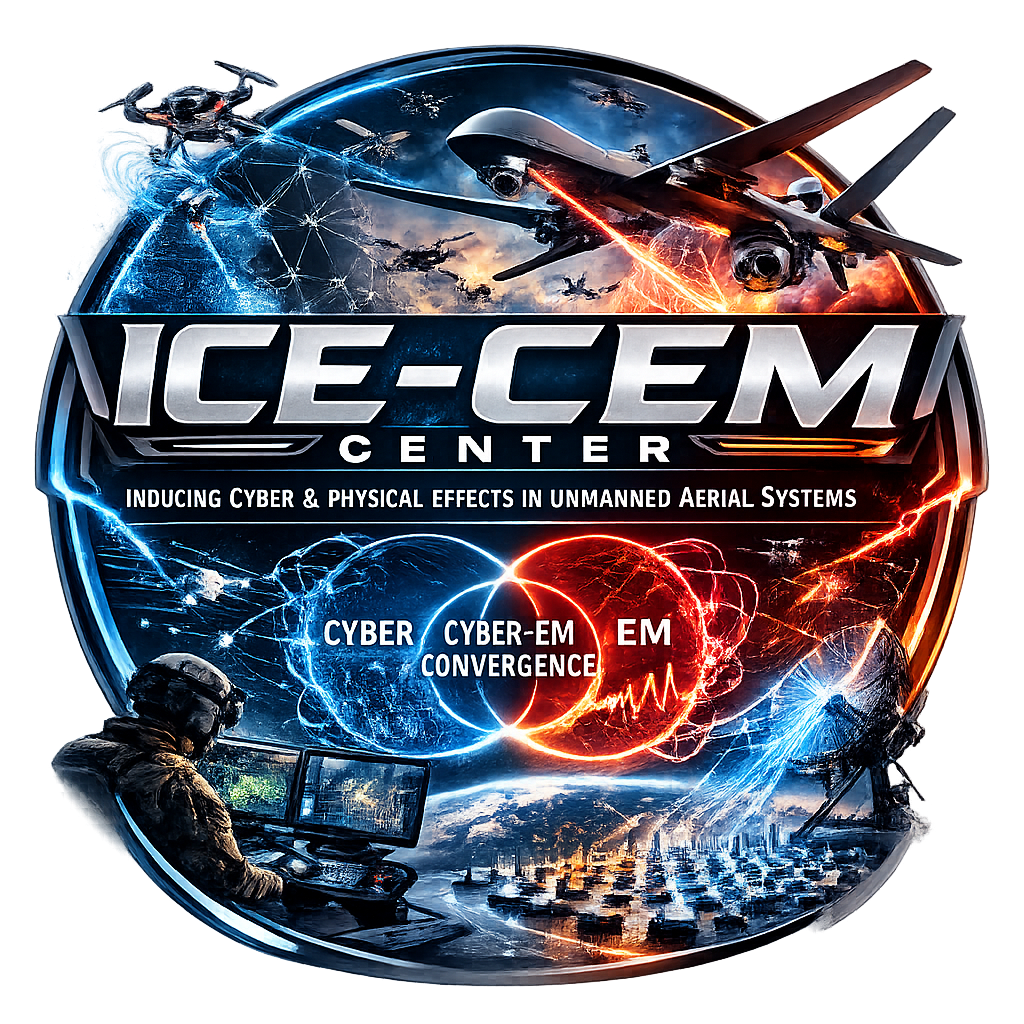 ICE-CEMDuke University
From isolated cyber and electromagnetic effects to coordinated, adaptive operations—at mission speed.
Led by Duke University, the DEVCOM ARO-supported ICE-CEM Center brings together research leaders from seven universities and Lockheed Martin Advanced Technology Laboratories to develop the scientific foundations of adaptive counter-UAS capabilities.
The team combines expertise in wireless systems and RF electronics, Global Navigation Satellite Systems (GNSS) and navigation warfare, cybersecurity, physical AI and cyber-physical systems, edge computing, AI and machine learning, game theory, and autonomy.
ICE-CEM RESEARCH
ICE-CEM will develop a unified framework for understanding, exploiting, and defending against cyber-electromagnetic (cyber-EM) interactions in current and next-generation UAS. We study how cyber and EM actions propagate through sensing, communications, hardware, computation and control—and how they can be combined to produce precise physical, cyber and reconnaissance effects. By formalizing this action-to-effect pipeline, we aim to translate mission-level objectives into coordinated actions with predictable outcomes, even with limited prior knowledge of the target.
Our research spans techniques, tactics and operations: reusable cyber-EM primitives, which exploit the EM threat landscape for UAS, and the technologies that enable them, are combined into tactics that affect UAS capabilities, then coordinated through AI-enabled reasoning into operations that adapt as targets and environments change. The ICE-CEM framework will establish the scientific foundations for adaptive cyber-EM kill-webs, with rigorously quantified tradeoffs among attack reliability, cost, energy, time and robustness under uncertainty and active countermeasures.
Electromagnetic Attack Primitives, Platforms, and Enabling Technologies
Cyber Exploitation and Trustworthy AI
Cyber-EM Convergence and Adaptive Operations
From Foundational Science & Technology to Realistic Operational Demonstrations
NOVEMBER 2–3, 2026
Our team and partners come together at Duke to launch a shared research agenda.
Meeting information ↗CENTER ANNOUNCEMENT
Read Duke’s announcement of the six-year, Army-supported ICE-CEM center.
Read the announcement ↗